Protein RDA: It Took Them About 50 Years
For decades, the protein RDA sat quietly in nutrition guidelines, textbooks, and food labels, telling people they were eating enough as long as they hit 0.8 grams per kilogram of bodyweight. It looked official. It looked scientific. And it was treated like a target.
Meanwhile, anyone working in strength, sport, or clinical nutrition knew something was off.
The idea of a protein RDA goes back to 1941, when the first recommendations were created during World War II. The goal was not performance, healthspan, or muscle preservation. The goal was simple survival. Later refinements, largely based on nitrogen balance studies from the 1950s to 1970s, shaped the number that stuck. In 2002, the Institute of Medicine formally reinforced 0.8 g per kilogram as the adult RDA.
That means the number most people still quote today is built on science that is half a century old, designed to prevent deficiency, not to support a strong, active body.
If you want the full background on how the original protein RDA was established and why it fell short in practice, you can read the earlier article here.
Somehow, that minimum became a recommendation.
Strength coaches, sports nutritionists, and researchers have been pointing this out for years. If you train. If you diet. If you want to preserve muscle. If you want to recover well. The RDA is not enough. This was not controversial in practice. It was only controversial on paper.
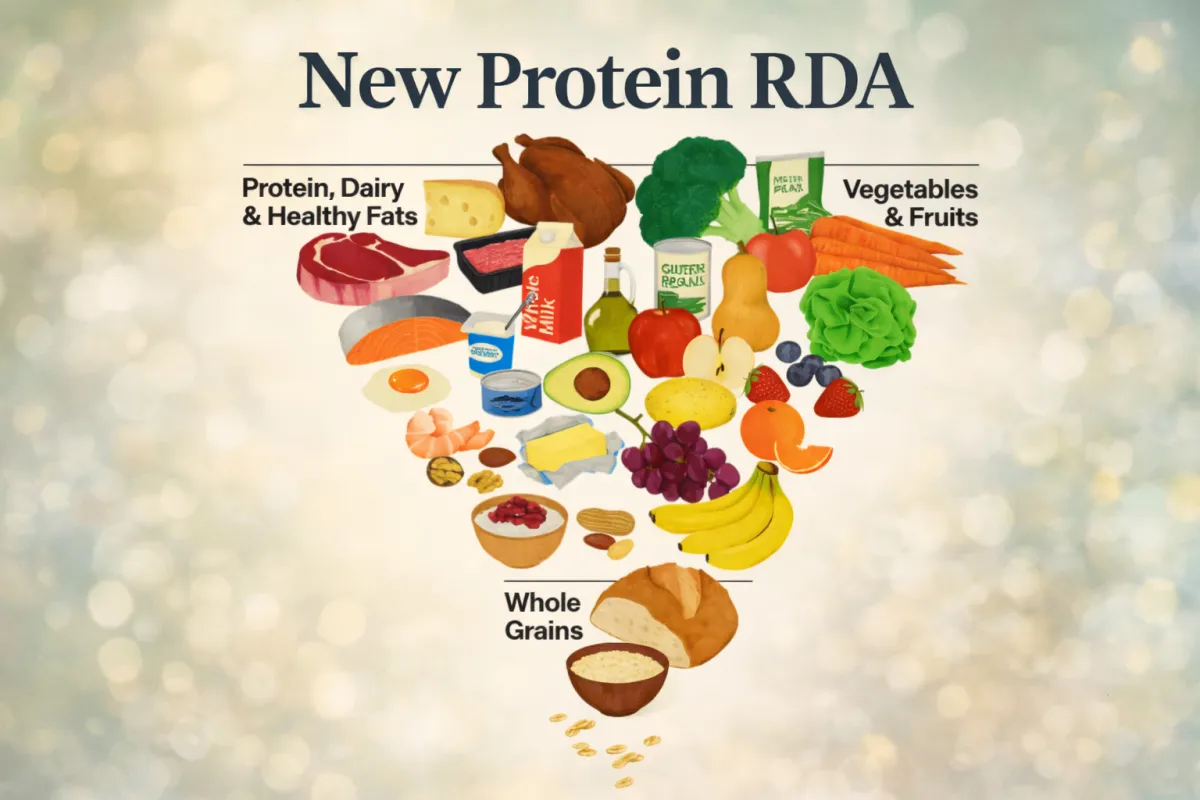
And then, quietly, things started to change. In recent years, the FDA has clarified how protein requirements should be interpreted. Early this year, the FDA released the "Dietary Guidelines for Americans 2025–2030" with updated nutritional guidance to prioritize higher-quality protein. The 2026 guidelines, sometimes referred to as a "new pyramid" or "inverted pyramid" design, emphasize increased protein, reduced processed foods, and improved dietary fat choices. In other words, they finally said out loud what professionals have been saying for decades.
It only took them about fifty years.
This matters because it changes the conversation. The RDA is no longer presented as an optimal intake. It is recognized for what it is. A floor. Not a goal.
One reason the old number held on for so long is how it was measured. Nitrogen balance studies can show someone as “adequate” even while muscle mass, strength, and recovery are slowly declining. You can technically meet the RDA and still lose muscle over time, especially during calorie restriction or periods of stress.
As research methods improved, so did our understanding. Studies using muscle protein synthesis and indicator amino acid oxidation consistently show that higher protein intakes better support lean mass, training adaptations, and functional outcomes. This is true for active people and becomes even more relevant when calories are lower.
That is why modern sports nutrition recommendations often go far beyond the RDA. Intakes up to 2.2 grams per kilogram are commonly used in athletic populations, especially during hard training or fat loss. These ranges did not come out of nowhere. They came from decades of applied work that simply took a long time to reach official language.
In my own programming, I typically plan protein intake around 1.8 to 2.0 grams per kilogram, particularly in a caloric deficit. Not because it is extreme, but because it protects muscle, supports recovery, and makes training sustainable when energy is lower.
Another issue with the old RDA framing is that it ignores how protein is eaten. Total daily intake matters, but so does distribution. Protein spread across meals provides repeated signals for muscle maintenance. Hitting the RDA in one large meal and underdosing the rest of the day is not the same thing.
Concerns about kidney health still surface whenever higher protein intake is mentioned. In healthy individuals without existing kidney disease, higher protein intakes have not been shown to impair kidney function. That fear has outlived the evidence supporting it.
The protein RDA was never evil. It did its job. It prevented deficiency. The problem was treating a minimum survival value as if it were a performance or longevity recommendation.
Now that even regulatory bodies acknowledge the difference, the confusion should finally start to clear.
The real question is no longer whether you hit the RDA. It is whether your protein intake actually supports the body you are trying to keep.
Knowing that the RDA is a minimum is only the first step. To apply higher protein intake properly, you need to know your actual calorie needs. You can estimate that using the TDEE calculator here.