
How Long Should You Rest Between Sets?
Walk into any gym and you will see two extremes. One person rushes through a workout like it is a race. Ten seconds between sets. Sweat everywhere. Heart rate through the roof. Another person finishes a set, sits down, checks messages, scrolls social media, talks to three people, and eventually remembers they are training. Both miss the point.
Rest between sets is not wasted time. It is part of the training itself. The length of your rest determines how much weight you can lift, how many repetitions you can perform, and how much real work your muscles complete.
If you want strength, muscle, or long term progress, rest periods matter more than most people realize.
Rest between sets is not wasted time. It is part of the training itself.
What Happens Inside the Muscle Between Sets
When you perform a hard set of resistance training, your muscles rely heavily on a rapid energy system based on ATP and phosphocreatine. These fuels power short bursts of intense effort. A heavy squat, a hard bench press set, a tough deadlift.
During the set those energy stores drop quickly. Once the set ends, the body begins restoring them. That restoration process takes time.
If you start the next set too soon, the tank is not full. The result is simple. Fewer reps means less weight, and this leads to lower quality of work. Over time that adds up to less progress.
Rest Periods for Strength Training
This is why rest periods should match the goal of the session.
If your goal is strength, longer rest periods are often necessary. Heavy compound lifts place a large demand on both the muscles and the nervous system. Squats, deadlifts, presses, and rows involve large muscle groups and high loads.
Trying to rush those sets rarely works well.
In strength focused training, resting two to four minutes between heavy sets often allows enough recovery to perform the next set with similar intensity. That recovery helps maintain force production and protects the quality of the workout.
This is why powerlifters often take longer breaks. They are not being lazy. They are preparing the body to produce maximal effort again.

Rest Periods for Muscle Growth
When the goal shifts toward muscle growth, the picture changes slightly.
Hypertrophy training usually uses moderate loads and higher training volume. The goal is to create sufficient mechanical tension and fatigue across multiple sets.
In this context, rest periods around one to two minutes often work well. This allows partial recovery so you can still perform strong sets while keeping the workout dense and challenging.
If rest periods are extremely short, performance drops too quickly. Repetitions fall off. Weight drops. The total amount of work done by the muscle decreases.
Muscle growth depends on sufficient training volume. If fatigue prevents you from performing quality sets, progress slows down.
That is why slightly longer rest periods often lead to better hypertrophy outcomes than very short ones.
Rest Periods for Conditioning and Endurance
Then there is muscular endurance and conditioning work.
Circuit training, bodyweight workouts, and certain metabolic sessions often use short rest intervals. Sometimes under sixty seconds. In these sessions the goal is not maximal strength but fatigue resistance and work capacity.
Short rest keeps the heart rate elevated and challenges the body's ability to sustain effort.
Different training goals require different rest strategies.
Why One Rest Rule Does Not Work
One mistake I often see is applying the same rest rule to every exercise.
One minute between everything.
A heavy set of barbell squats should not have the same rest period as a set of lateral raises or triceps pushdowns. Large compound lifts require more recovery. Smaller isolation exercises demand far less.
The weight matters as well.
A set taken close to failure creates more fatigue than a light warm up set. It naturally requires more recovery time before the next effort.
Experience level also plays a role.
Advanced lifters typically need longer rest periods because they lift heavier loads and create more fatigue with each set. Beginners often recover faster simply because the absolute loads are lower.
A Simple Rest Strategy That Works
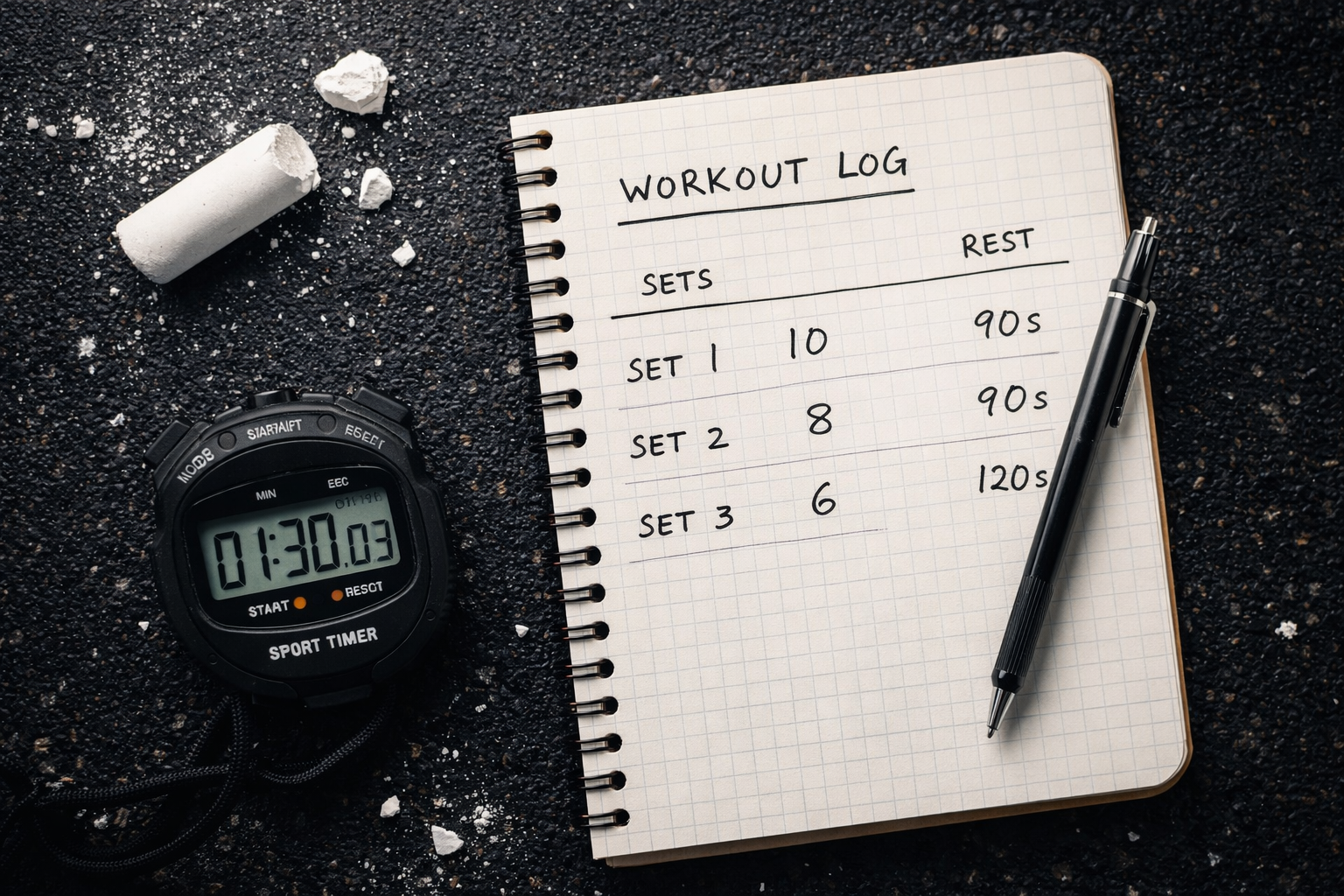
In practical terms, a simple structure works well for most people. Heavy compound lifts often need two to four minutes of rest. Moderate hypertrophy work often benefits from one to two minutes. Small isolation movements usually work well with sixty to ninety seconds.
You do not need to stare at a stopwatch for every set. But you should pay attention to how prepared you feel for the next one.If every set becomes weaker and weaker, your rest periods are probably too short.
Recommended Rest Periods Between Sets
Heavy compound lifts
2 to 4 minutesHypertrophy training
1 to 2 minutesIsolation exercises
60 to 90 seconds
The Real Role of Rest in Training Progress
Strength training is not about rushing. It is about accumulating quality work over time.
More weight lifted and more repetitions completed. More total training volume performed across weeks and months. Rest periods help protect that quality.
Training is a cycle of stress and recovery. A hard set creates stress, and rest allows the body to prepare for the next challenge.
Repeat that cycle consistently and the body adapts.
Strength grows.
Muscle develops.
Health improves.
Muscle is not just decoration. It is an organ of longevity. Training it properly requires effort, patience, and the right amount of recovery.
If you want to understand how strength training supports long term health, read Coach Haris' full guide on strength training for longevity.